In Plain Words
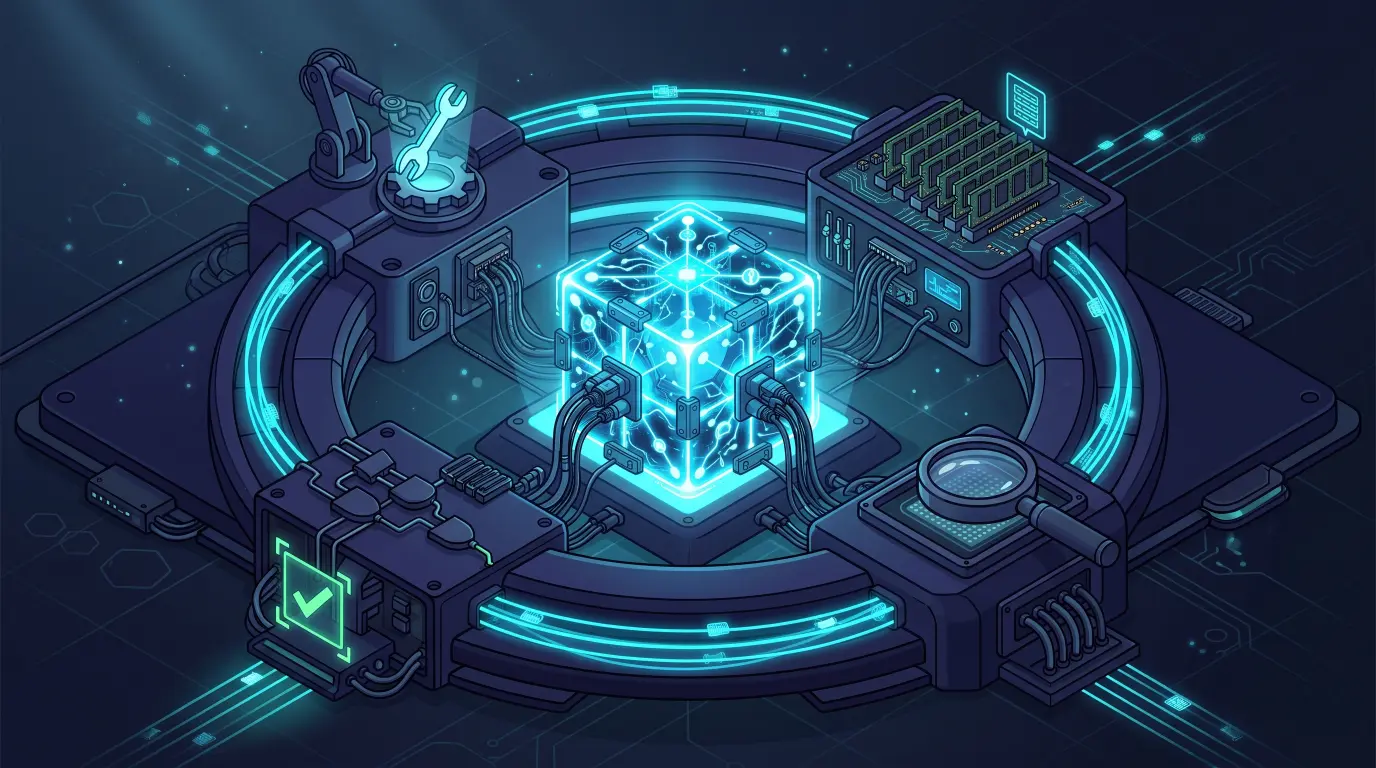
A language model on its own does one thing: it reads text and predicts more text. It cannot open a file, run a command, call an API, or check whether its last answer was correct. An AI harness is the code that gives it those abilities. It takes the model's output, acts on it in the real world, feeds the result back, and asks the model what to do next, over and over, until the job is finished.
That loop is the whole idea. The community shorthand is Agent = Model + Harness: the model supplies the reasoning, the harness supplies everything else. Vendors now use the word in their own docs. Claude Code's documentation says the layer that provides the tools and manages the context the model sees "is what the term agentic harness refers to", and OpenAI titled its write-up on building with Codex "Harness engineering". It is usually the part that decides whether an agent finishes a task or stalls halfway through.
How It Works
A harness wraps the model in a control loop. Each turn through that loop runs roughly the same steps:
- Assemble context. Build the prompt the model will see: the system instructions, the task, recent tool results, and any retrieved memory. When the context window fills, the harness summarizes or trims it.
- Call the model. Send that context and read back the response, which is either plain text or a request to use a tool.
- Execute tools. If the model asked to run a command, read a file, or query an API, the harness runs it and captures the output, including errors.
- Feed results back. Append the tool output to the context so the next call can react to what actually happened.
- Decide whether to stop. Check whether the task is complete, the budget is spent, or a guardrail tripped. If not, loop again.
Stripped to its core, a harness is a short loop around a single model call:
context = build_context(task)
while not done:
    reply = model.generate(context)          # the model reasons
    if reply.tool_calls:
        results = run_tools(reply.tool_calls)  # the harness acts
        context = append(context, reply, results)
    else:
        done = is_complete(reply)             # the harness decides
return reply
Real harnesses add more around this skeleton: permission prompts before risky commands, retries when a tool fails, self-critique steps, sub-agents, and verification gates such as running the test suite before declaring success. The pattern of reasoning, acting, and observing in a loop is often called ReAct, and tool use itself rides on a model's structured tool-calling interface. How those tools get described and connected to the model is increasingly handled by shared protocols like the Model Context Protocol.
Why It Matters
The harness compensates for what a raw model cannot do. A model that writes code but never runs it has no way to notice a syntax error or a failing test. Wrap that same model in a harness that runs the code, reads the stack trace, and lets it try again, and it finishes tasks the bare model would fail outright.
This is why two products built on the identical model can perform very differently. In the Terminal-Bench 2.0 paper's own runs, GPT-5 resolved 49.6% of tasks inside Codex CLI and 33.9% inside Mini-SWE-Agent, and Gemini 2.5 Pro scored 32.6% in Terminus 2 against 15.7% in OpenHands. The harness controls what context the model sees, which tools it can reach, and how many chances it gets to self-correct. Don't read that as "the harness beats the model", though. The same paper concludes that model selection usually matters more than the agent scaffold, so a good harness gets the most out of a model rather than replacing a better one. Designing that layer has become its own discipline, now usually called harness engineering. Birgitta Böckeler at Thoughtworks describes it as a specific form of context engineering.
If you build with agents, the harness is also where your real engineering effort goes. Picking a model is a one-line decision. Choosing which tools to expose, how to manage memory across a long session, when to ask the user for permission, and how to verify output is the work, and it is the part you can actually improve. The shift shows up across the stack, from provider SDKs that standardize tool calling to platform vendors turning agents into first-class API products. What the harness puts in that context is itself a security decision: Claude Code's account email ended up in a User-Agent header because it sat in the model's context.
Origin
The word borrows directly from "test harness" in software engineering: the scaffolding that wraps a unit under test to feed it inputs, capture outputs, and make its behavior repeatable. An AI harness plays the same role for a model, feeding it context and capturing its actions. The term spread through late 2025 and 2026 because it named something teams were already building, a model plus its loop and tools, without having agreed on a word for it. Anthropic was calling its Claude Agent SDK a "general-purpose agent harness" by November 2025, and by spring 2026 OpenAI, LangChain and Thoughtworks had all published pieces built around the word.
Harness, Scaffold, and Model
These three terms get used loosely, sometimes interchangeably. The useful distinction is what each one is responsible for.
| Layer | What it is | Responsible for |
|---|---|---|
| Model | The language model itself. | Reasoning and generating text or tool-call requests. Nothing else. |
| Scaffold | What the model sees. | System prompt, tool descriptions, output parsing, what gets remembered each step. |
| Harness | What runs the loop. | Calling the model, executing tools, managing context, deciding when to stop. |
In casual use, "harness" often covers the scaffold too. When someone says Claude Code or Codex is "a harness," they mean everything that is not the model. The narrower split above is worth knowing when a discussion turns to who owns which behavior.
A harness is also not the same as an agent framework. A framework like LangGraph or one of the agent SDKs is a toolkit for building a harness. The harness is the specific running loop you end up with. You can write one from scratch in a few dozen lines, or assemble it from a framework.